
Generative AI initially changed cybercrime by helping people write, research and automate individual tasks. Security researchers are now observing a more consequential shift: agentic systems that can chain multiple steps together with less human intervention.
Recent Google Threat Intelligence research described adversaries using AI-enabled workflows to accelerate cloud abuse and credential-harvesting activity. The important point for a small business is not science fiction. It is compression of time.
Security fundamentals still matter
AI does not make patching, MFA, endpoint protection, backups or logging obsolete. It increases the value of doing those fundamentals consistently and responding quickly when they produce an alert.
What CyberEase recommends
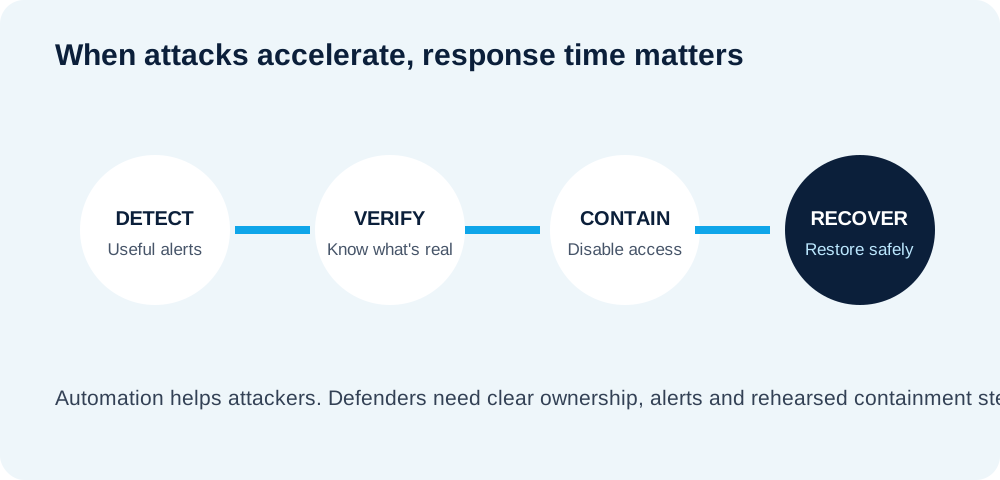
Know who receives security alerts. An alert without an owner is not a control.
Protect identities. Use strong authentication and limit unnecessary privileges.
Patch exposed systems promptly. Reduce the easy opportunities automation can exploit.
Have containment steps ready. Know how to disable an account, isolate a device, revoke sessions and contact key vendors.
Test recovery. Backups matter only when they can be restored reliably.
For most SMBs, the sensible response to agentic threats is not buying an “AI security” product because the label sounds modern. It is making identity, monitoring, endpoint protection and incident response work as a coherent system.
Source: Google Threat Intelligence research on adversarial use of AI and agent-enabled attack workflows.
Simple IT. Strong Security. — CyberEase