

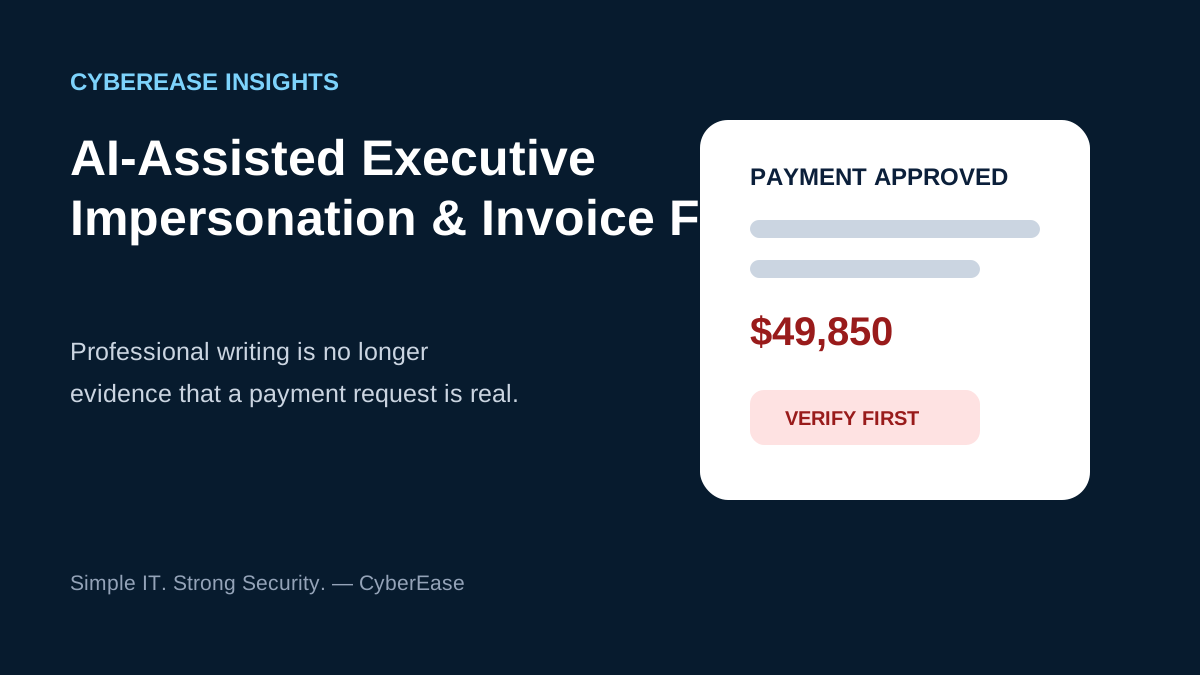
Business email compromise has always relied on trust: a message appears to come from an executive, supplier or colleague and asks someone to move money quickly.
Recent Microsoft research described a large executive-impersonation campaign targeting financial workflows, with indicators consistent with generative AI helping attackers construct and tailor messages. The important lesson for small businesses is not that AI makes fraud unstoppable. It makes superficial clues such as awkward grammar less useful.
Change the process, not just the training
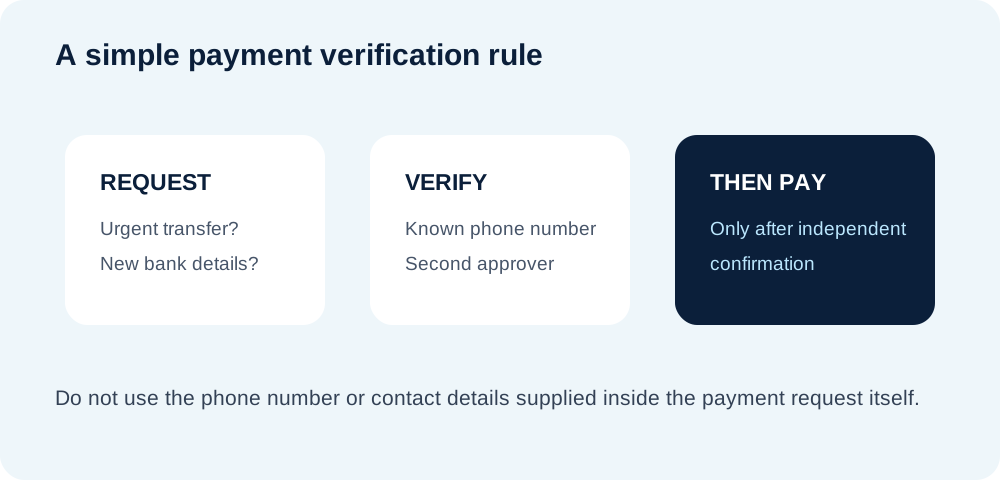
The strongest response is an independent verification rule for unusual payments, new banking information and changes to vendor payment instructions.
What CyberEase recommends
Verify out-of-band. Call the requester using a phone number already on file, not one supplied in the email.
Require a second approval. Larger or unusual payments should require another authorized person.
Treat bank-detail changes as high risk. Verify them independently before updating vendor records.
Protect email accounts. Strong authentication and monitoring still matter because a compromised real mailbox can make fraud even more convincing.
AI changes the quality and scale of social engineering. A good approval process remains effective because it focuses on the business action the attacker wants, not whether the email sounds authentic.
Source: Microsoft Security research on AI-assisted executive impersonation and financial fraud.
Simple IT. Strong Security. — CyberEase