

Generative AI has changed the economics of social engineering. Attackers can produce polished messages quickly, adapt wording for a particular role or organization and generate many variations without spending much time on each one.
Microsoft's threat research has documented threat actors using generative AI to support phishing and social-engineering activity. Recent research on invisible-character phishing also shows ideas associated with AI security research being repurposed in conventional attacks.
What is actually different?
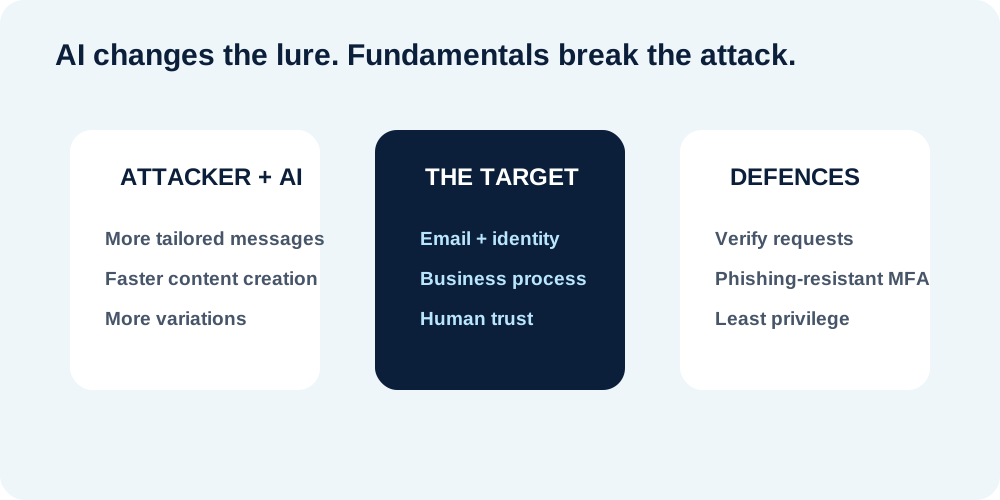
Quality: awkward grammar is becoming a less useful warning sign.
Personalization: public information can be turned into role-specific messages more easily.
Scale: attackers can create and modify lures faster.
Experimentation: AI helps criminals rapidly test different wording and approaches.
What still works?
Verify sensitive requests outside the message. Especially payments, password resets, banking changes and confidential data.
Use phishing-resistant MFA. Make a stolen password less valuable.
Limit privileges. A compromised everyday account should not automatically provide administrator access.
Keep devices and browsers updated. Social engineering is often paired with technical exploitation.
Teach context. Employees should recognize unusual behaviour and business requests, not hunt for spelling mistakes.
The productive response to AI-enabled phishing is not panic. It is making the business processes attackers depend on harder to abuse.
Simple IT. Strong Security. — CyberEase
Want practical protection against phishing?
CyberEase helps businesses strengthen Microsoft 365, identities and security awareness.